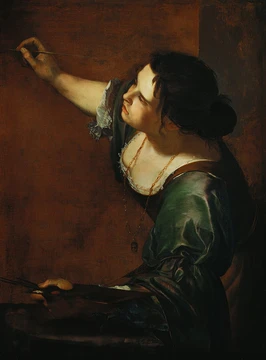
Tintoretto
Venetian Renaissance painter known for speed, boldness, and dramatic Mannerist style.

Jacopo Robusti (late September or early October 1518 – 31 May 1594), best known as Tintoretto, was an Italian Renaissance painter of the Venetian school. His contemporaries both admired and criticised the speed with which he painted and the unprecedented boldness of his brushwork. For his phenomenal energy in painting he was termed il Furioso ('the Furious'). His work is characterised by muscular figures, dramatic gestures and bold use of perspective, in the Mannerist style.
- born
- Late September or early October 1518
- died
- 31 May 1594
- field
- Painting
- nationality
- Italian (Venetian school)
- known_for
- Speed of painting, bold brushwork, muscular figures, dramatic gestures, bold perspective; nicknamed il Furioso
Lore & Background
Tintoretto was born in Venice in 1518, the son of a dyer, Battista. The nickname Tintoretto means 'little dyer' or 'dyer's boy'. He had at least one sibling, a brother named Domenico, though an unreliable 17th-century account says his siblings numbered 22. The family was believed to have originated from Brescia in Lombardy, then part of the Republic of Venice; older studies gave Lucca as the origin. Little is known of his childhood or training. According to early biographers Carlo Ridolfi (1642) and Marco Boschini (1660), his only formal apprenticeship was in the studio of Titian, who angrily dismissed him after only a few days—either out of jealousy or because of a personality clash. From then the relationship remained rancorous, with Titian actively disparaging Tintoretto. Tintoretto sought no further teaching but studied on his own, working alongside artisans who decorated furniture, studying anatomy by drawing live models and dissecting cadavers, and collecting casts, bas-reliefs, and prints. At some time, possibly in the 1540s, he acquired models of Michelangelo's Dawn, Day, Dusk and Night, which he and his workshop studied in numerous drawings. He placed over his studio the inscription 'Il disegno di Michelangelo ed il colorito di Tiziano' ('Michelangelo's drawing and Titian's colour').
Reader's Guide
Tintoretto's significance lies in his distinctive Mannerist style, marked by muscular figures, dramatic gestures, and bold perspective, as well as his phenomenal energy in painting, which earned him the nickname il Furioso. His career was shaped by rivalry with Titian and later with Paolo Veronese, and by his willingness to work quickly and cheaply to secure commissions. The most notorious incident of his career was his subterfuge to win the commission for the Scuola Grande di San Rocco in 1564: instead of submitting a sketch, he secretly installed a full-sized painting on the ceiling and offered it as a gift, knowing the foundation could not reject a gift. His large-scale works, such as the two tallest canvases of the Renaissance for the Madonna dell'Orto (c. 1559–1560), and his series for the Scuola di San Rocco (1565–1567 and 1575–1588), demonstrate his ability to complete massive projects on limited budgets. His legacy includes a vast body of work that influenced later Venetian painting, though his hasty execution was both admired and criticised by contemporaries.
Did You Know?
- Tintoretto's nickname means 'little dyer' or 'dyer's boy', derived from his father's profession as a dyer.
- His only formal apprenticeship was in Titian's studio, but he was dismissed after only a few days.
- He placed the inscription 'Michelangelo's drawing and Titian's colour' over his studio.
- He won the commission for the Scuola Grande di San Rocco by secretly installing a full-sized painting on the ceiling and offering it as a gift.
Frequently Asked Questions
Who is Tintoretto?
Tintoretto was the popular name of Jacopo Robusti, a painter from Venice who worked during the Italian Renaissance. He remains one of the most recognized figures of the Venetian artistic tradition.
What is Tintoretto known for?
His reputation rests on two main qualities: the remarkable speed at which he worked and the raw, forceful nature of his brushstrokes. His paintings are filled with strongly built human figures caught in sweeping poses, often set within dramatically angled spaces.
Why was Tintoretto nicknamed 'il Furioso'?
The nickname, meaning 'the Furious,' reflected how his peers perceived his almost violent intensity at the easel. People in his time were struck by both how fast he painted and how boldly he handled his pigments.
What artistic school and period does Tintoretto belong to?
He worked within the Venetian school of the Italian Renaissance, and his style aligns with Mannerist tendencies such as elongated anatomy and heightened theatricality. His career placed him in the same Venetian milieu as Titian and Veronese.
When was Tintoretto born and when did he die?
Jacopo Robusti was born in late September or early October of 1518 and passed away on 31 May 1594. His working life therefore stretched across most of the sixteenth century in Venice.
More in Old Masters 1-22
Spotted an error? Know more?
This is a living reference — every entry is fact-audited, and reader corrections feed straight into our audit queue. Suggest an edit · See this site's audit record